Preface
For a local newspaper, I covered the 94 wildfire in central Washington. Looking back, I see some striking differences in how citizens interacted with their firefighters then vs. now. In fact, historical fire coverage this summer doesn't even go back to 1994 - that's prehistory to today's reporters. They have no idea how things were on the residential frontlines of firefighting. So as a courtesy to today's readers who weren't around back then, I'm reprising my original story.
1994 Wildfires around Lake Chelan in Central Washington
If the jet skis on Lake Chelan are any indication, life
there didn't slow down a bit during the devastating Cascade fires of July and August. The pilot of a landing Chelan Airways Beaver was asked by a passenger if he ever hit any jet skis.
"No, but some of them come pretty close," he answered. Jet
skiers are notorious for riding and jumping the wakes of float
planes and the big passenger boats of the Lake Chelan Boat
Company.
That was on August 16, 1994, a smokey day on the lake. From a few
miles up the north shore of the lake, at night, you could look
across and see the fires above Slide Ridge, near Lake Chelan
State Park on the south shore. The fires made me think of the
remark of a former employer.
"If I want to watch something that's depressing, I'll go
watch a forest fire,' he said. He was a TV station manager,
commenting on some programs of the day.
I decided to watch the Milky Way instead, floating on my
back in the cooling lake waters. It shined with a clarity
impossible on the light-polluted Interstate-5 side of the
mountains.
Smoke here comes and goes from the resorts that line the
south shore of Lake Chelan. Ashes accumulate on cars in the
parking lots, beach walkers and swimmers bend over to see what
all the black stuff washed ashore is - charcoal chips and flakes
that went airborne in the fires, then doused themselves by
landing in the lake. It will continue until October snows blanket
the remaining, "controlled," fires.
I went to the other side of the lake to see the firefighter’s activities at 25-Mile Creek State Park. It had been taken over as their staging area to serve both as a place to sleep and as a launching pad for up-mountain efforts. Up-mountain efforts defy what most of us would consider a day's work. One of those efforts is to pat the burned-over ground to check for warmth. Rattlesnake bites aren't in the job
description, but they do happen.
A staff briefing was going on in the shade of the entrance compound, which was lined with a couple of dozen two-person tents. The scene had all the look of a third world military officers’ row. But for the uniforms and all the guys in yellow shirts, it could have been a California camp scene from "The Grapes of Wrath."
Three slow movers raked the early fall leaves in the compound, stuffed them into garbage bags and drove them away in a pickup truck.
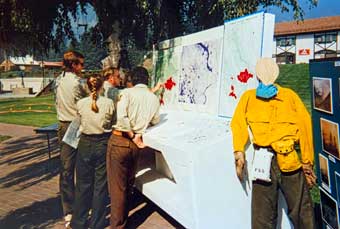
US Forest Service briefing on the local fire zones
A National Park Service officer in Stehekin had described
the mass firefighting effort as militaristic. "Not a military
operation," he said, "but militaristic." There were "Incident
Commanders" for every firefighting effort.
At 25-Mile Creek State Park I talked with a yellow shirt
who identified himself as "Deputy Logistics Section Chief for
this camp." We talked over the buzz of two jet skis and a power
boat pulling a lot of guys in identical green trunks in a Sea
Biscuit - R & R for the troops.
He said this was the Tyee Spike Camp, composed of 550 marines, 157 National guardsmen and 200 miscellaneous logistical people who do planning, camp security and communications operations.
A van with Oregon plates drove out of camp. On the side it
said, “Wildfire Emergency Strike Team.”
I had trouble understanding the Deputy Logistics Section
Chief's reference to Humvees and Deucendahalfs. "Excuse me," I
said. "Is that a German vehicle? I'm not familiar with it."
That sure broke the ice. "That's a two-and-a-half-ton truck, son," he said, "a deuce and a half."
I told him about the fire engine red Humvee I'd seen at the
Seattle Car Show. He had to admit that he'd never seen one so
spiffed up.
Hughes was his name, Michael Hughes, from the Eugene
District of the USDI Bureau of Land Management.
Hughes had been in camp for two weeks and had but one chance
to eat in nearby Chelan. He noticed all the green bows and signs of
thanks to the firefighters, in every store front in town, and he
appreciated them.
"They really show a great community spirit and support for
what we're doing," Hughes said. "We appreciate it."
Chelan citizens kept giving cakes and cookies to the troops.
One resident even overheard a firefighter say he hadn't eaten in
24 hours, and launched a campaign over KOZI Radio to feed the
men. The next thing anyone knew, 1,000 casseroles turned up in
camp, in addition to apples, peaches and corn.
One retired couple in Chelan heard of the firefighters' need
for a few thousand handkerchiefs to wear over their noses and
mouths. They got together with two other couples, set up a bank
of sewing machines and "ripped 'n stitched" donated cloth for
days.
| |
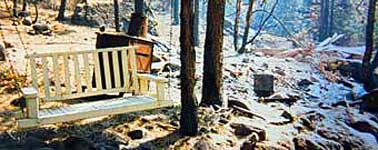
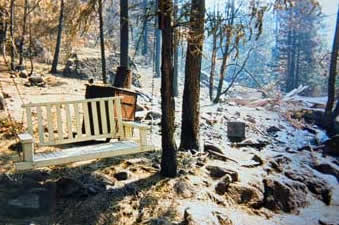
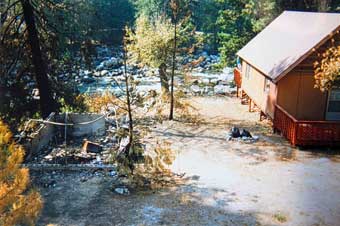
Fire damage to Icicycle Creek homes in 1994. When firefighters had the manpower, several would guard a house to keep the fire away. |
|
Hughes said he and the boys were moving out "at 0900 hours
tomorrow morning." Everybody's on a 21-day rotational system.
After 21 days on the lines, firefighters are required to go home
for at least four days. After that they can be called up again.
"They may be called to another fire," Hughes said. "And
that could be anywhere in the West."
We shook hands and parted over the whine of the rollicking
jet skis, but not before he said, "I assume you'll tell the
truth about what goes on here."
"You bet," I answered. "Isn't that what we both do?"
ABOUT THE AUTHOR:
| |
 |
|
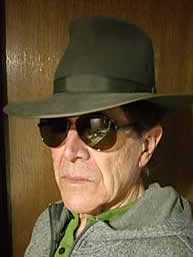
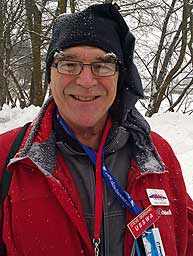
Web manager Steve Giordano, past president of the Society of American Travel Writers, is a veteran ski and travel journalist & photographer whose work has appeared in newspapers, magazines, books, radio and television and many places around the Internet. He's written numerous travel books. Steve is the designer and technologist of HighOnAdventure.com and was the online and guidebook editor of SkiSnowboard.com. He can be reached at rsgiordano@gmail.com. |
|
 |
|
| |
Author as seen by himself |
|
|
|
Author as seen by others |
|
|