 |
|
CAPITOLS AND CATHEDRALS OF THE LOWER DANUBE PART 2 - BELGRADE, SERBIA |
|||
Story and photos by Brad Hathaway |
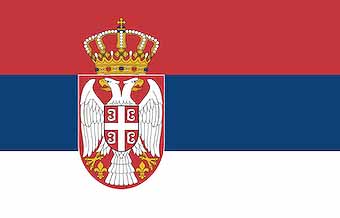
We continue our series exploring the capitol buildings of the capital cities along the lower reaches of the mighty Danube River with a visit to Serbia — a nation of incredibly long history dating to the stone age. (The oldest fossil discovered to date is at least 400,000 years old.) Today some six and a half million people, mostly Serbs, occupy this portion of what used to be Yugoslavia in a land-locked nation nestled amongst Hungary, Romania, Bulgaria, North Macedonia, Croatia, Bosnia and Herzegovina, Montenegro and maybe Albania (the border area is disputed). A prominent portion of its border is, of course, the beautiful Danube River on which we are cruising. But we have a few sights to catch before we get to Serbia.
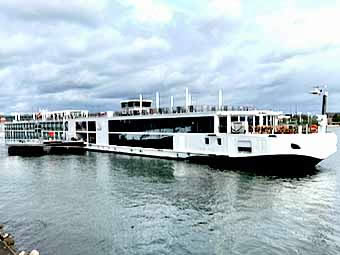
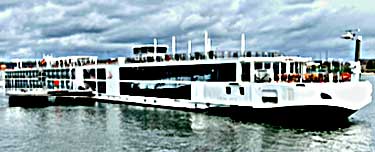
Having driven to the Danube from Romania’s capital of Bucharest, we boarded our cruise ship - a Viking longboat with accommodations for fewer than 200 passengers - in the Romanian port of Giurgiu.
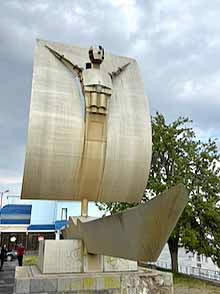
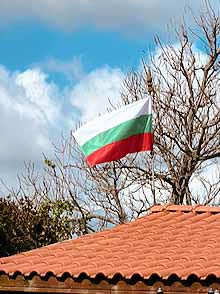
At dock-side there is a striking sculpture of Ulysses (or Ulise in Romanian). Constructed out of the same steel used in the shipyard of Giurgiu, it pays tribute to the city’s dual heritage in the ship building trade and in shipborne transport. Once we were aboard, the ship simply sailed across the river to the Bulgarian side and the port of Russe where a different flag flew. It took all of 14 minutes.
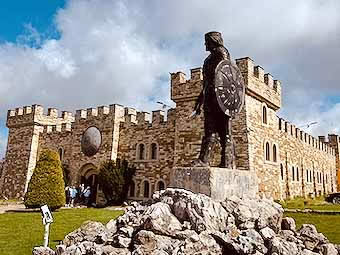
We drove into the country a bit. First stop—what looks like a medieval fortress on the plateau above Arbanasi. It isn’t centuries old, it is actually a newly-built event center that hosts tours, events and weddings.
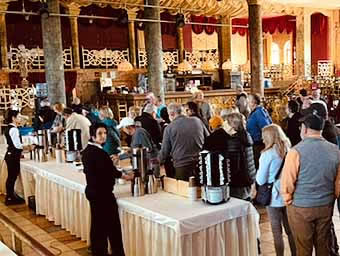
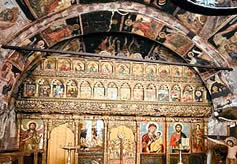
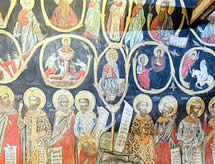
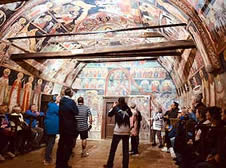
We stopped at this “Kaloyanova Fortress” long enough to grab a bite in their buffet and take a photo or two—that is supposed to be Tsar Kaloyan from the Second Bulgarian Empire in the 13th Century standing guard. I tend to doubt anyone really knows what Kaloyan actually looked like. The reason for our drive into Bulgaria was to visit a church of note: Arbanasi’s Orthodox Church of the Nativity of Christ. The interior walls are covered in iconic paintings of stories from the life of Christ and innumerable apostles and saints—some 20,000 square feet of them! The majority of them were painted in the 1630s and 1640s, although some date back as early as the 1500s. Note the line of saints in the lower part of the middle photo. These are individual portraits of Jesus’s apostles.The artist or artists attempted to give individual apostles distinct personalities.
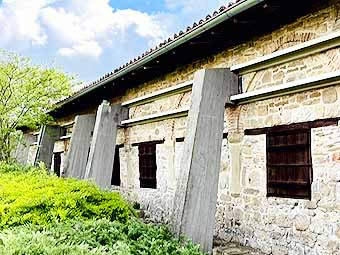
As fascinating as the interior walls might have been (and they were fascinating!), I found the exterior walls architecturally intriguing because they are held up by a set of flying buttress-like supports barely fifty years old. They were added as part of a major renovation in the 1970s which addressed damage that was done by an earthquake in 1913.
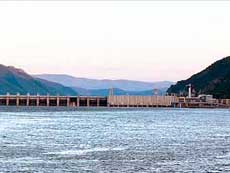
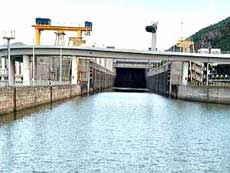
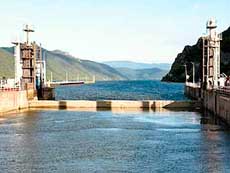
Back on the water, we continue up the Danube, approaching the spot where it leaves Bulgaria behind and begins to form the border between Romania on our right and Serbia on our left. Thus far, the Danube has been fairly free-flowing, not greatly different than it had been through the ages. Oh, there were dredged areas that used to be too shallow for transit and stretches that had rapids that used to require the portage of cargo for part of the trip. But the Danube still, to steal a line from America’s Show Boat, just kept rolling along. The stretch we were about to enter had once been so treacherous at certain times of the year that the Danube wasn’t really a year-round transportation route. In the 1970s and 80s that changed with the opening of two dams with giant locks allowing river ships like our longship to rise up or lower down depending on our direction of travel while maintaining the water level at a steady, navigable level. They raised the level over a hundred feet which not only served transportation, it provided water for hydroelectric generation. Combined, the Iron Gate dams are rated at almost 3,000 megawatts.
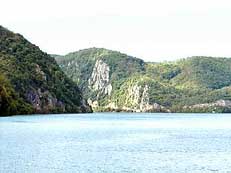
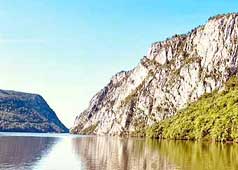
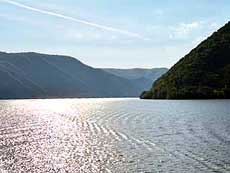
While this stretch of the river was a part-time hazard with frequent blockage, today it is more like a placid reservoir with steep hills on either side.
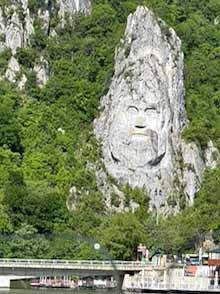
As we passed through, our attention was drawn to one of the exposed peaks of rock where a nearly 200 foot high face stared down at us. It is the face of Decebalus, a king of the realm of Dacia in what is now mostly Romania. He was the last of the Kings to fight the Roman Empire here. Constantin Drǎgan, a local businessman who wanted the story of Dacia to gain more prominence, had it carved here in the 1990s, and is now the tallest rock relief in Europe.
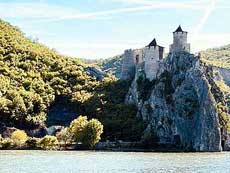
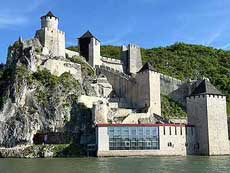
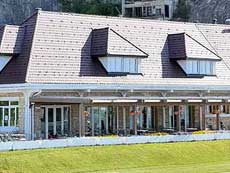
Further up the Danube along the Serbian border we exited the Iron Gate section of the river at Golubac, site of a 14th-century fortress that has been restored with the addition of a modern visitor center to attract tourists cruising the river or touring the countryside. It was here that ships going down the Danube would be stopped for tolls as a chain was stretched across the river at one of its narrowest spots. This, of course, made passage impossible without paying the toll to have the chain briefly lowered to the river bottom to allow crossing. In different centuries the spot was held by various powers including Serbs, Hungarians and Turks.
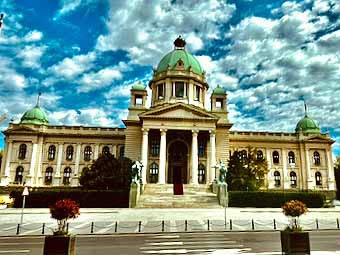
Our voyage finally brought us to Serbia’s capital city of Belgrade. We had only one day to check out the sights and, unfortunately, that day was a Sunday. So the capitol - the House of the National Assembly of the Republic of Serbia - was closed. All we could do was capture a photo.
Construction of the neo-baroque building was begun in 1907 but was interrupted first by the Balkan Wars of 1912 and 1913 by the Balkan League of Bulgaria, Greece, Montenegro, and Serbia against the Ottoman Empire. Construction was halted again by World War I and then again by the Great Depression. It was finally opened in 1936 and houses not only the country’s unicameral legislature, it also has a large, luxurious library with more than 60,000 books. Sunday didn’t keep us from seeing other points of interest throughout the town. The huge Kalemegdan Park, on a high plateau overlooking the point where Serbia’s Sava River empties into our Danube, was once a fortress and training ground for the Ottoman Army during the centuries of Turkish rule (1521 to 1867).
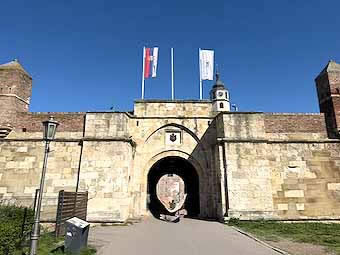
Within the park is the old Ottoman fortress. The gate to that fortress was built in the middle of the eighteenth century and named for Istanbul - or Stanbol in Turkish - as it spanned the road to Constantinople, modern Istanbul.
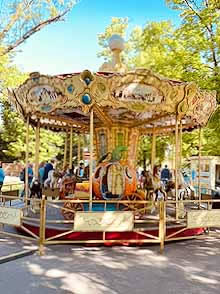
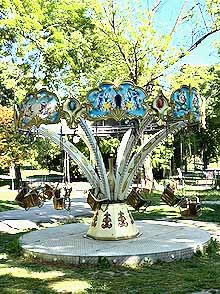
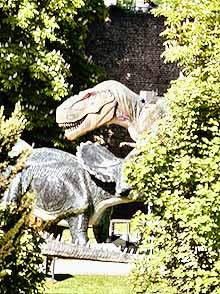
The park offers activities for children and families. There is a traditional carousel as well as a flying swing, and a playfield with statues of dinosaurs that all entice many children to request a trip to the park.
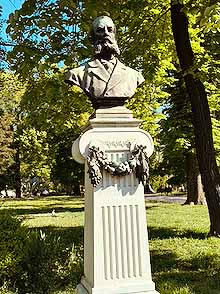
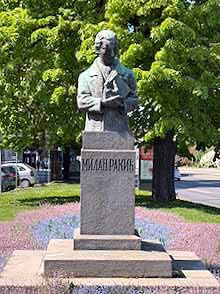
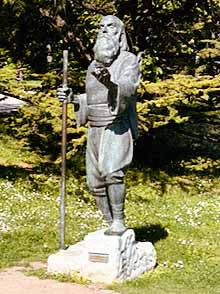
As with many large municipal parks in Europe, there are quite a few sculptures and memorials. There is a memorial bust of Kosta Taušanović, a prominent Serbian politician of the later part of the nineteenth century. There is another of Milan Rakić, a Serbian poet from the early twentieth. Then there is a sculpture of a Blind Guslar or minstrel by Paško Vučetić which is all that remains of a major collection of sculptures that were part of a monument celebrating Serbian victories. That monument was destroyed by the Austro-Hungarians when they occupied Belgrade during World War I.
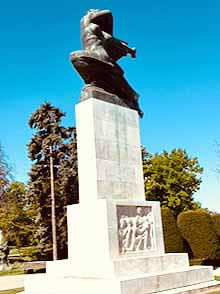
A prominent Monument of Gratitude to France was dedicated in 1930 to pay tribute to the relationship of the French and Serbian armies, their medical teams and cultural partnerships during World War I. It was the work of Croatian and Yugoslav sculptor Ivan Meštrović.
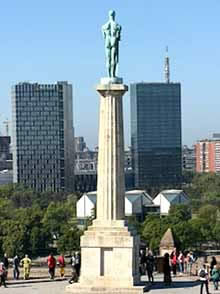
On the edge of the plateau stands Pobednik (“The Victor” in English), a statue commemorating Serbian victories over not only the Ottoman Empire but also the Austro Hungarian Empire in the Balkan Wars. It stands here, instead of in downtown Belgrade where it was originally supposed to be displayed, because the powers that be in the 1920s couldn’t bring themselves to display a naked male in such a public spot. Instead, it was placed high up on the cliff of the plateau with its front facing the river and the empty plains and woods beyond. During the post-World War II era when Serbia was part of Yugoslavia, that area became an urban project now called New Belgrade, with high-rise apartments complete with a frontal view of The Victor!
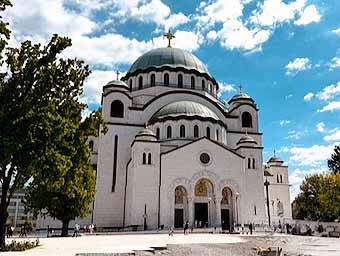
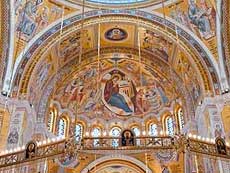
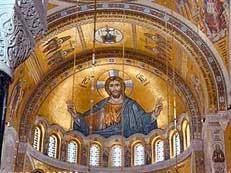
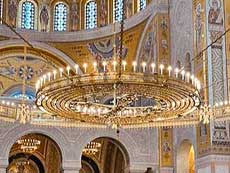
While we couldn’t visit the interior of the House of the National Assembly, we were certainly welcomed to visit one of the largest and most impressive Orthodox churches in the world: Hram Svetog Save or The Temple of Saint Sava. Sava The Enlightener, who died in 1235, was the founder of the Serbian Orthodox Church. Sited on the Vračar plateau, the temple dominates the skyline of Belgrade. That location is important historically as well as visually. It was on this spot in 1595 that the Ottoman occupiers incinerated the relics of the saint in an effort to put down Serbian uprisings. Construction was begun in 1935 but was halted by the Nazis during the occupation of World War II, and then prohibited by Yugoslav leaders for most of the period of time that Serbia was part of Yugoslavia. Construction was finally approved to continue in 1985.
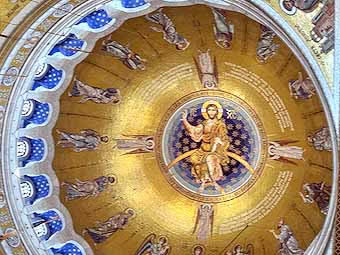
The building reflects the design of the Hagia Sophia in Istanbul with a huge dome over a grand display of mosaics. Indeed, with more than 150,000 square feet, these gold-leaf and precious stone mosaics are among the largest displays of any church in the world.
Our last stop on this tour of capitals on the lower Danube will take us to Budapest, Hungary. It will be featured in the January/February issue of High On Adventure. Join us then! ABOUT THE AUTHOR
|