 |
|
A WEEK IN ORTIGIA AT THE FOOT OF ITALY’S SIRACUSA |
|||
Story and photographs by Brad Hathaway |
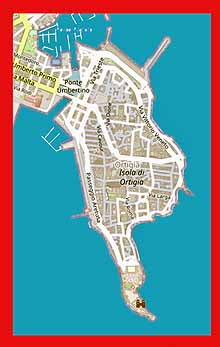
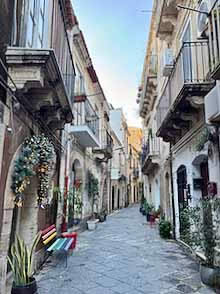
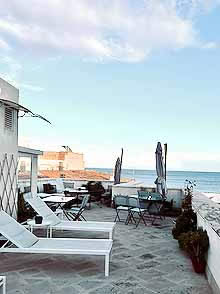
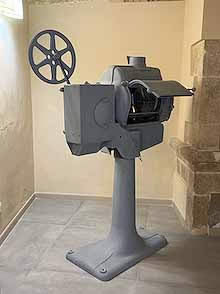
Spending a week in Italy poses a problem. Italy is so big there’s too much to see in a week. So, we decided to limit ourselves to Sicily. But even Sicily alone has too much to see in a week. So — how about just the city of Siracusa? Nope. Still too much. But on the southern tip of Siracusa there is an island called Ortigia which is less than half a mile wide and only a bit more than a mile long. It has so much to see that it filled the week with highlight after highlight. We booked a room in a lovely boutique hotel on a typically narrow street and found it offered a marvelous balcony overlooking the Ionian Sea. Its name, the Lanterne Magiche, came from the fact that it houses some of the collection of the Cinema Museum of Siracusa.
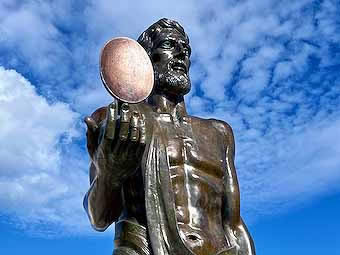
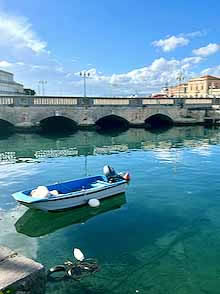
During the entire week we stepped off the island only once — and that was just to take a photo of a statue at the foot of the bridge linking the island to the city of Siracusa. The statue was the famous Greek mathematician, astronomer, engineer and physicist Archimedes. He lived here some two thousand three hundred years ago, when Ortigia was actually the entire city of Siracusa. It was once a serious rival to Athens for the title of greatest Greek city. While Athens eventually won that battle, in later days the Roman Cicero said that Siracusa was “the greatest Greek city and the most beautiful of them all.” Today, the Archimedes statue shows him with a mirror in his hand, a reference to a legend — improbable in the extreme — that he devised a system of concave mirrors to concentrate so much sunlight on the sails of attacking naval ships that it set them on fire. Whatever you think of the story, the statue is striking.
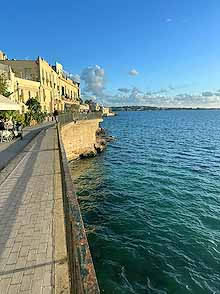
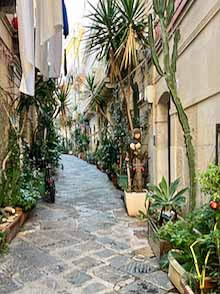
Once you cross back over the bridge, you come upon a very small world bounded by waterfront roads at the edges, filled between with narrow streets flanked by buildings constructed out of the white limestone quarried right on the island.
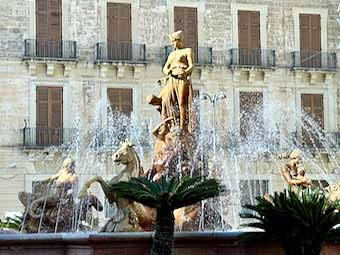
Many of those buildings were constructed in the eighteenth century following the 1693 earthquake that all but destroyed the entire city and much of the rest of Sicily. Gone were the ancient buildings, but Siracusa had a great amount of a unique limestone with which to re-build. Known as pietra bianca, it is soft enough to carve by hand, but once exposed to sun and weather, it hardens and develops a gold-toned whiteness. Open spaces were retained, such as what is today known as Piazza Archimedes, where in 1907, the public water supply fountain was replaced by a grand fountain dedicated to Diana, daughter of Zeus and sister of Apollo. (I am at a loss to explain how she is both the goddess of virginity and of childbirth.)
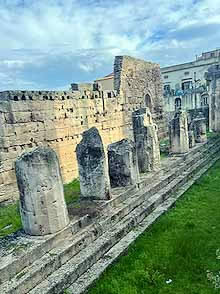
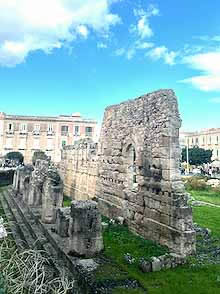
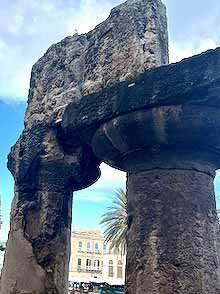
The remains of the Roman Temple of Apollo were allowed to remain in place, visible for future visitors.
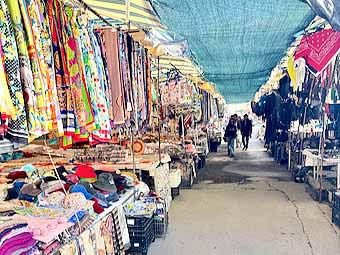
Adjacent to the Temple of Apollo is the Ortigia Street Market which seems to cater to both tourists looking for trinkets and locals in search of fresh produce, fish, pasta and, because this is Sicily, a great selection of Sicilian pistachios for the evening meal.
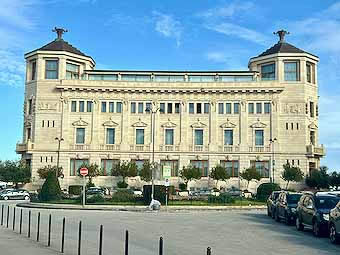
There are some larger buildings such as the 5-star Ortea Palace Hotel in what was once the post office at a time when a post office also handled telegrams, long distance telephone service and money transfers. The building, which is right at the foot of the bridge onto the island from downtown Siracusa, was designed to be impressive. There are also restaurants in all sections of the island serving fine fare for tourists and residents alike. One we found that offered a particularly warm welcome to accompany a varied menu of food and drink, had the interesting name of Scuola Alimentare which translates as Learn by Eating.
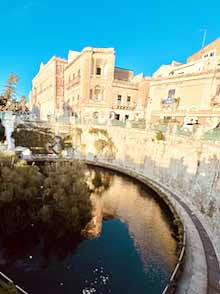
A most interesting open area surrounds a pond on the edge of the island. It is unusual to find a fresh water pond right next to a salt water bay or ocean but — here in Ortigia — is just that. It seems there is a fresh water aquifer stretching under the island and the main area of the city that is deep enough to go under the channel free from any salt-water intrusion. A spring bubbles up which has been named the Fountain of Arethusa after the Greek legend of a sea nymph by that name. She was bathing in a river in Greece when a god saw her and fell in love, which in Greek mythology always seems to mean sex, not affection. She rejected his advances and tried to swim away from him down the river. She swam so far she ended up in Sicily on the island of Ortigia — hence the fountain.
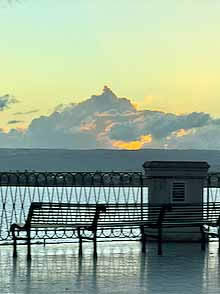
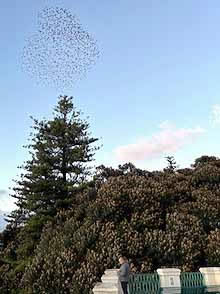
The pond is big enough to provide fresh water to the inhabitants and to visiting ships as well as having space left over to raise papyrus reeds. In Greek, Roman and Norman days the reeds were used to make papyrus paper. This is why Ortigia is also home to its own Papyrus Museum — worth a morning or afternoon visit by itself. Adjacent to the pond is a viewing platform where you can watch the sun setting over the mainland of Sicily. On one night of our visit, as the sun was setting, a flock of sparrows prepared to light in their favorite grove of trees, flying in the fascinating formation known as a murmuration, before actually landing for the night in the grove.
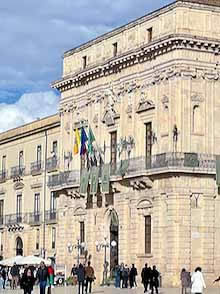
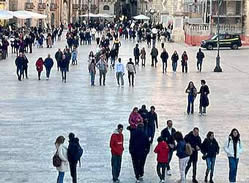
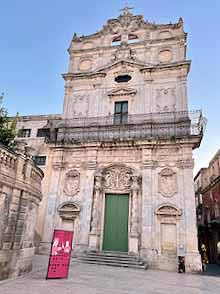
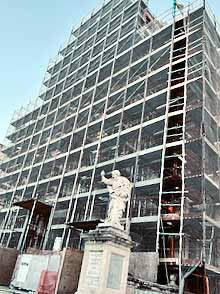
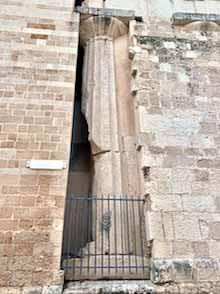
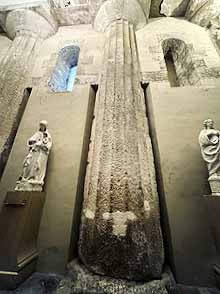
By far the most interesting and most visited open area on the island is the Piazza del Duomo di Siracusa. It is unlike most piazzas in Italy in that it is not a square or even a rectangle. Instead, it is a semi-ellipse surrounded by baroque style buildings, including the city hall, some private residences, boutique hotels and the Church of Santa Lucia alla Badia, one of a number of churches in Siracusa dedicated to Lucia who is the patron saint of the city. The main attraction on the piazza is, of course, the cathedral or duomo. Its baroque facade, dating from the middle of the eighteenth century is currently sheathed in construction scaffolding while it undergoes renovation and restoration — but history tells its tale anyway. If you walk around the side you find the walls are not just medieval construction — they include embedded columns. These columns are two thousand years older than the cathedral! They are the remains of a temple to the goddess Athena built by the Greeks after their victory over Carthage in 480 BC. They are also visible on the inside of the cathedral.
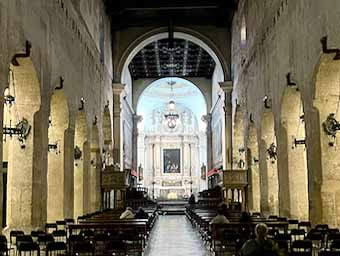
The duomo’s nave is surprisingly plain although the apse is highly sculptured in the baroque style with a painting of the “Nativity of the Virgin Mary” as its centerpiece. The arches flanking the nave date to the Byzantine period of about 600 AD while its wooden roof is the work of the Normans in the eleventh century.
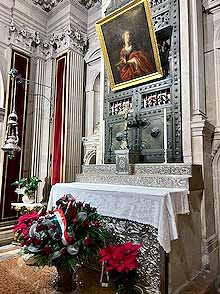
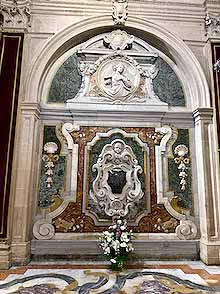
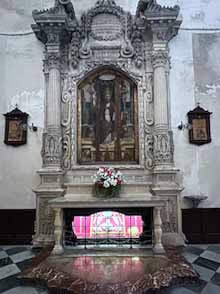
Things get quite a bit more decorative on one side of the nave where three chapels were added, including one devoted (again) to Saint Lucia. In fact, one of the most important articles in the cathedral’s collection is a bone from her left arm — relics are important here. Most of her remains are held in a church in Venice but the bone from her arm was “returned” in 1988. There are also some fragments from her ribs and some clothing and shoes in this nave. Saint Lucia was tortured and burned in 304 AD as a Christian, having been accused of that then-illegal status by a suitor whom she had rejected. She is often portrayed with a sword stuck in her throat and holding a tray on which are her eyes, which tradition says were gouged out of her head just before she was burned to death.
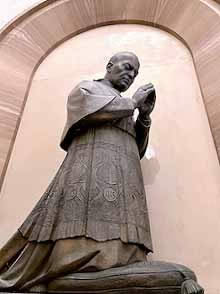
Amidst the elaborately ornate baroque chapels a strikingly modern sculpture caught my eye. It shows Ettore Baranzini kneeling in prayer. He was the Archbishop here in the 1950s when the city was obsessed with the story of a possible miracle as a plaster image of the “Immaculate Heart of Mary” in the home of a local family seemed to weep tears. Baranzini led the investigation that finally declared that the miracle of “Our Lady of Tears” really was a miracle.
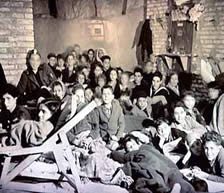
Outside the duomo, the piazza is paved with polished white limestone. The buildings surrounding the piazza are also made of this material. Under the piazza’s paving, where once was solid limestone, are found a labyrinth of chambers and tunnels that were carved out to provide the stone for building projects. In World War II these tunnels provided air raid shelter space for the entire population. You can tour it today to get a feel for how claustrophobic it must have been for those who sat feeling the shaking and hearing the blasts of Axis bombs all through the night.
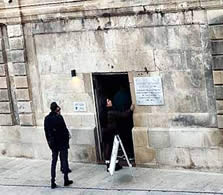
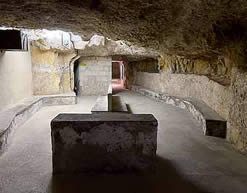
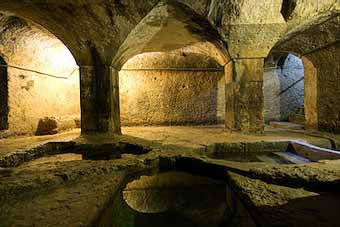
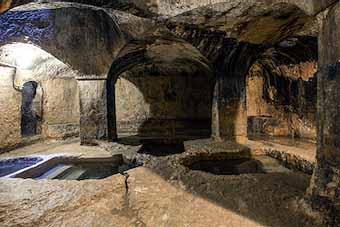
Another fascinating underground feature lies just a thousand feet to the east of the duomo on a lovely narrow street called Via G. B. Alagona. Beneath a boutique hotel called the Alla Giudecca is the Bagno Ebraico, an ancient Jewish ritual bath (a “mikva”) that may date to as early as the sixth century. Here, in the heart of what once was a thriving Jewish community, a trench was dug through the limestone far enough to pierce the aquifer to feed a series of pools which were used for ritual bathing. But in 1492, when Sicily was under Spanish rule, the Jews were expelled from the entire Spanish Empire. Probably to prevent their religious sites from being despoiled, they filled the mikva with soil. It wasn’t until the 1990s, when the buildings above the site were being renovated and converted to hotel use, that the soil was removed and the mikva re-discovered.
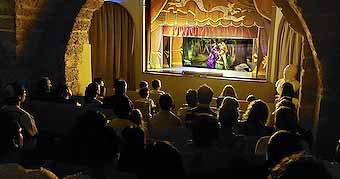
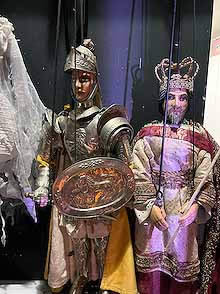
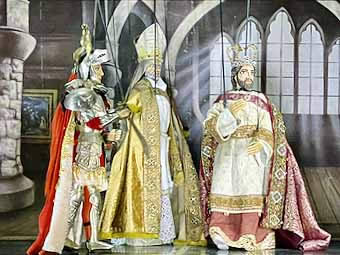
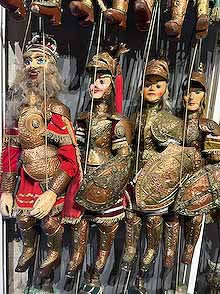
Sicily as a whole is known for its tradition of puppet theaters. Indeed, the United Nations Educational, Scientific and Cultural Organization (UNESCO) has determined that Sicilian puppetry is a “Masterpiece of the Oral and Intangible Heritage of Humanity.” You can find this specific type of puppetry known as Opera dei Pupi in The Puppet Theatre of Siracusa.
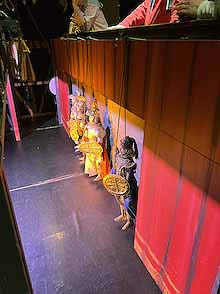
Operated by Alfredo Mauceri with a tight little team of less than half a dozen, the company not only provides traditional puppet shows in their intimate theater, they maintain a museum where you can explore the history of this particular brand of puppetry. It involves large, heavy, luxuriously costumed and sculpted characters operated like marionettes from above but with a metal rod supporting the main body. The size, weight and support are necessary because the stories always involve the medieval legends of Charlemagne and, thus, the male characters are often armed knights with a sword in one hand and a heavy metal shield on the other arm. No show would be complete without a frantic sword battle.
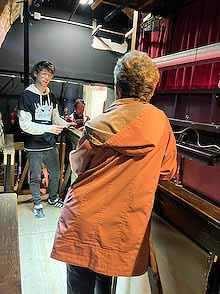
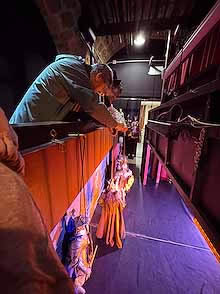
The theater kindly gave us a tour backstage to see how their particular type of magic is produced. They even let me try my hand at operating one of the armed knights — but fortunately not during a performance so as to spare the audience from my lack of that skill.
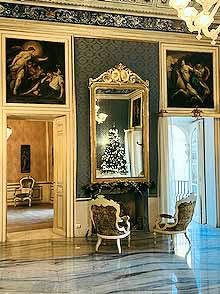
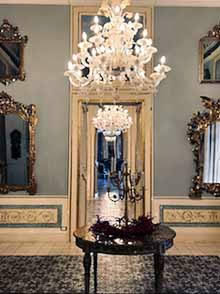
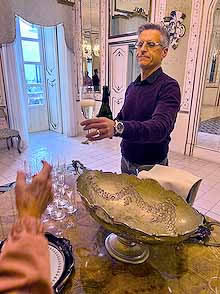
Ortigia has a long history of palaces and palazzos, some of which are open for tours such as we took of the Palazzo Borgia del Casale which dates to 1760. Its Rococo interior is impressive and the tour ends with a glass of prosecco.
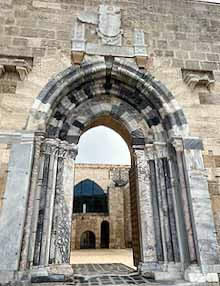
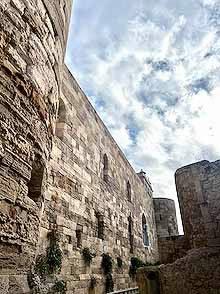
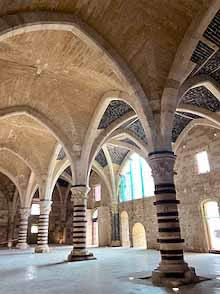
At the very foot of the island, furthest from the bridge where we saw Archimedes and his mirror, is a massive structure that has served as a fort, a palace and a prison over the last thousand years. It began as a fortress built by the Holy Roman Empire to defend Sicily, but it goes back even further as the site had already been a Byzantine fortress for two hundred years. Today it is called the Castle Maniace because the Byzantine general who had it built in 1038 was George Maniakes.
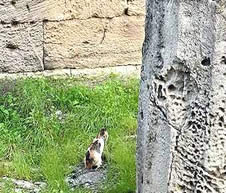
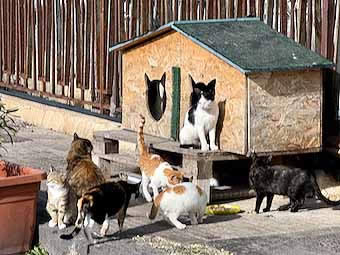
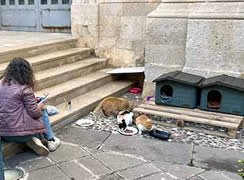
And one last observation — Cats. Cats! CATS! It seems that cat colonies (colonie feline) have been declared a civic heritage protected by law which “establish(ed) the right to existence of colonies of free-roaming cats.” Thus it is against the law to mistreat or remove the cats. You will not only see cats roaming all around the island, you will see habitats set up for them that look like small motels or houses. You will also notice many people tending to their needs.
After our week on Ortigia we’d be happy to spend another week or two or three on the island. We might even find time to cross over the bridge and explore the wonders of the rest of Siracusa. ABOUT THE AUTHOR
|